Free Guitar & Ukulele Online Tuner免费在线吉他 / 尤克里里调音器
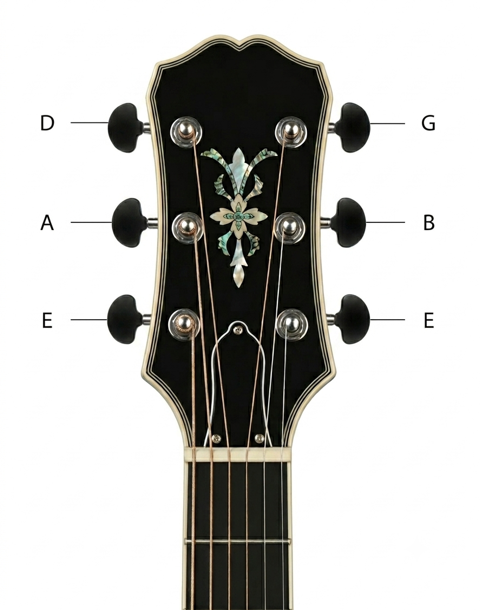
This online tuner helps you tune a guitar or ukulele by ear and with your device microphone. Tap any string on the headstock to hear a reference tone, then adjust the tuning peg until the pitch matches. Auto mode detects which string you are playing; manual mode lets you pick a specific note.
这款在线调音器支持听音定弦与麦克风检测两种方式。点击琴头琴弦播放参考音,再转动弦轴将音高校准。自动模式会识别你拨的是哪根弦,手动模式可指定单根弦进行调音。
Standard Guitar Tuning — EADGBE吉他标准定弦 EADGBE
Most acoustic and electric guitars use standard tuning: from the thickest string (6th) to the thinnest (1st), the notes are E – A – D – G – B – E. The low E is the root of countless songs; the high E gives brightness for melodies and solos.
大多数木吉他与电吉他采用标准定弦:从最粗的 6 弦到最细的 1 弦,音名为 E – A – D – G – B – E。低音 E 是许多和弦与 riff 的基础,高音 E 则常用于旋律与 solo。
Standard guitar string notes and frequencies| String · 弦 | Note · 音名 | Frequency · 频率 |
|---|
| 6 | E2 | 82.41 Hz |
| 5 | A2 | 110.00 Hz |
| 4 | D3 | 146.83 Hz |
| 3 | G3 | 196.00 Hz |
| 2 | B3 | 246.94 Hz |
| 1 | E4 | 329.63 Hz |
Standard Ukulele Tuning — GCEA尤克里里标准定弦 GCEA
Soprano, concert, and tenor ukuleles are usually tuned to G – C – E – A (high-G re-entrant tuning). The 4th string G is tuned higher than the C string, giving the ukulele its bright, cheerful character. Baritone ukuleles often use DGBE like the top four guitar strings — this tuner uses the standard GCEA layout.
高音、音乐会型与 tenor 尤克里里通常定弦为 G – C – E – A(High-G 重入定弦)。4 弦 G 音高于 3 弦 C,形成尤克里里特有的明亮音色。Baritone 尺寸常用 DGBE(类似吉他高音四弦),本工具采用最常见的 GCEA 标准定弦。
Standard ukulele string notes and frequencies| String · 弦 | Note · 音名 | Frequency · 频率 |
|---|
| 4 | G4 | 392.00 Hz |
| 3 | C4 | 261.63 Hz |
| 2 | E4 | 329.63 Hz |
| 1 | A4 | 440.00 Hz |
Concert Pitch — A440 Standard标准音高 A440
Modern tuners and orchestras use A440: the A above middle C (written as A4) equals 440 Hz. All reference frequencies on this page follow equal temperament tuned to A440 — the same system used by digital tuners, piano keyboards, and most recorded music.
现代调音器与管弦乐团普遍采用 A440标准:中央 C 上方的 A 音(A4)为 440 Hz。本页各弦参考频率均基于 A440 的平均律计算,与电子调音器、钢琴及大多数录音一致。
- Ukulele 1st string (A4) = 440.00 Hz — the tuning anchor for GCEA.
- Guitar 1st string (E4) = 329.63 Hz; low E (E2) = 82.41 Hz — all derived from the same A440 scale.
- Some ensembles use A442 or A439; for everyday practice, A440 is the standard reference.
- 尤克里里 1 弦 A4 = 440.00 Hz,是 GCEA 定弦的基准音。
- 吉他 1 弦 E4 = 329.63 Hz,6 弦 E2 = 82.41 Hz,均来自同一 A440 音阶。
- 部分乐团使用 A442 或 A439;日常练习以 A440 为准即可。
Baritone Ukulele Tuning — DGBEBaritone 尤克里里定弦 DGBE
Baritone ukuleles are the largest common size and are tuned D – G – B – E (D3, G3, B3, E4) — identical to the four highest strings of a guitar. The sound is warm and full, closer to a small guitar than a soprano uke. This tuner's ukulele mode uses GCEA; for baritone, switch to guitar mode and match strings 4 through 1 (D, G, B, E).
Baritone 尤克里里是常见尺寸中最大的一种,定弦为 D – G – B – E(D3、G3、B3、E4),与吉他高音四弦相同,音色温暖饱满。本工具尤克里里模式为 GCEA;若你使用 Baritone,可切换至吉他模式,对照 4–1 弦(D、G、B、E)调音。
Baritone ukulele string notes and frequencies| String · 弦 | Note · 音名 | Frequency · 频率 |
|---|
| 4 | D3 | 146.83 Hz |
| 3 | G3 | 196.00 Hz |
| 2 | B3 | 246.94 Hz |
| 1 | E4 | 329.63 Hz |
Low-G Ukulele TuningLow-G 尤克里里定弦
In low-G tuning, only the 4th string changes: G3 (196 Hz) instead of high G4 (392 Hz). Strings 3–1 stay C4, E4, A4. Low-G gives a wider range and fuller bass, popular for fingerstyle and solo arrangements. You need a thicker wound or fluorocarbon low-G string — a standard high-G string cannot be tuned down to G3 safely.
Low-G 定弦仅 4 弦不同:由 G4(392 Hz)改为 G3(196 Hz),3–1 弦仍为 C4、E4、A4。Low-G 音域更低、低音更饱满,常用于指弹与 solo 编配。须使用专用 Low-G 弦(缠绕弦或氟碳线),普通 High-G 弦无法安全降至 G3。
Low-G ukulele tuning compared to standard| String · 弦 | Note · 音名 | Frequency · 频率 | vs Standard · 对比标准定弦 |
|---|
| 4 | G3 | 196.00 Hz | Low-G (was G4) |
| 3 | C4 | 261.63 Hz | Same as standard |
| 2 | E4 | 329.63 Hz | Same as standard |
| 1 | A4 | 440.00 Hz | Same as standard |
String Care & When to Change Strings换弦保养与何时换弦
Well-maintained strings stay in tune longer and sound brighter. Regular care also protects the fretboard and extends the life of your instrument.
保养得当的琴弦音准更稳定、音色更明亮,也有助于保护指板、延长乐器寿命。
Daily & Weekly Care
- Wipe strings with a dry cloth after every session to remove sweat and oils.
- Wash hands before playing — dirt accelerates corrosion.
- Store in a case; keep acoustic guitars around 45–55% humidity when possible.
- Avoid leaving the instrument in hot cars or direct sunlight (detunes and damages wood).
- Check tuning pegs: loose gears cause slipping; overtight screws can strip.
日常保养
- 每次练完后用干布擦拭琴弦,去除汗渍与油脂。
- 演奏前洗手,污垢会加速琴弦氧化。
- 放入琴盒保存;木吉他尽量维持 45–55% 湿度。
- 避免暴晒或留在高温车内,易导致脱音与木材损伤。
- 检查弦轴松紧,过松易滑丝,过紧可能损坏齿轮。
When to Replace Strings
- Sound is dull or muddy even after tuning.
- Strings no longer hold pitch for more than a few minutes.
- Visible rust, dark discoloration, or flat spots from frets.
- One string breaks repeatedly — replace the full set for balanced tension.
- Rule of thumb: every 1–3 months with regular play, or longer if you play rarely.
何时换弦
- 调准后音色仍发闷、不清晰。
- 音准无法维持,拨弦后很快跑音。
- 出现锈迹、变色或品丝处压扁。
- 同一根弦反复断弦 — 建议整套更换以保持张力均衡。
- 参考周期:常规练习每 1–3 个月,不常练可适当延长。
Tips After Installing New Strings
- Install one string at a time if you are new to restringing.
- Wind 2–3 neat coils on each peg; avoid overlapping wraps.
- Tune up to pitch, then gently pull each string away from the fretboard to stretch it.
- Re-tune — new strings may need 3–5 stretch-and-retune cycles before they stabilize.
- Trim excess string at the peg once tuning holds steady.
新弦装好后
- 新手建议逐根更换,避免全部取下后搞混顺序。
- 弦轴上绕 2–3 圈,排列整齐、避免重叠。
- 调至目标音高后,轻拉琴弦使其伸展(stretch)。
- 重复调音 — 新弦通常需 3–5 次拉伸后再调才能稳定。
- 音准稳定后剪去弦轴处多余弦头。
How to Tune
- Select guitar or ukulele above.
- Tap a string label or tuning peg for the reference tone.
- Pluck the same string on your instrument.
- Turn the peg: sharp → loosen; flat → tighten.
- Stop when the gauge reads In Tune (±5 cents).
调音步骤
- 在上方选择吉他或尤克里里。
- 点击琴头音符或弦轴,听取参考音。
- 拨动乐器上对应的琴弦。
- 音偏高则放松弦轴,偏低则拧紧。
- 指针居中、显示 In Tune(±5 音分)即完成。
Frequently Asked Questions
- Why tune one string at a time?
- Tuning each string to a fixed reference pitch (EADGBE or GCEA) keeps the whole instrument in equal temperament, which sounds best for chords and playing with others.
- 为什么要逐根弦调音?
- 将每根弦校准到固定音高(EADGBE 或 GCEA),可保持平均律音准,和弦与合奏时更和谐。
- Do I need to allow microphone access?
- Only for live pitch detection. You can still use reference tones without a microphone by tapping each string in manual mode.
- What if my ukulele uses low-G tuning?
- This tuner uses high-G (G4) for ukulele string 4. For low-G (G3 at 196 Hz), tune by ear against a G3 reference, or use guitar string 3 (G3) in guitar mode as a comparison pitch.
- 我用的 Low-G 尤克里里怎么调?
- 本工具尤克里里模式 4 弦为 High-G(G4)。Low-G(G3,196 Hz)可对照 G3 参考音听音定弦,或切换吉他模式,用 3 弦 G3 作为对比音高。
- Can I tune a baritone ukulele with this tool?
- Yes. Select guitar mode and tune to D3, G3, B3, E4 — the same notes as guitar strings 4 through 1. See the baritone table above for exact frequencies.
- Baritone 尤克里里能用这个调音器吗?
- 可以。选择吉他模式,对照 D3、G3、B3、E4 调音,即吉他 4–1 弦音高。详见上方 Baritone 定弦表。
- Why does my new guitar keep going out of tune?
- New strings stretch and settle over the first few days. Stretch each string gently after tuning, retune several times, and avoid heavy bending until pitch stabilizes. Old or corroded strings also slip more easily — consider a fresh set.
- 新吉他为什么老跑音?
- 新弦需要几天时间伸展稳定。每次调音后轻拉琴弦,多次重复调音,稳定前避免大幅推弦。旧弦或氧化弦也更容易滑音,可考虑换一套新弦。
← Back to Quick Help Guide · 返回首页